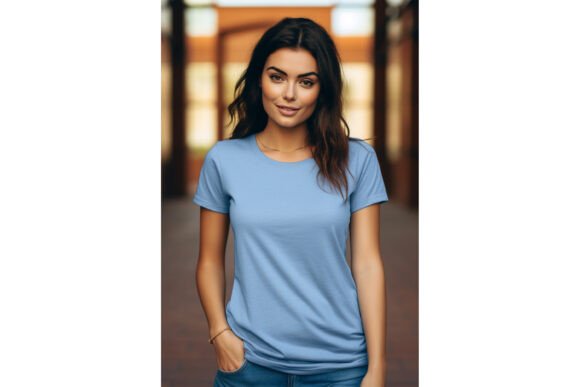
Reviewing the Female Blue T-Shirt Mockup for Embroidery
As a designer who spends half my day digitizing patterns and the other half managing client expectations, I have learned that presentation is just as critical as stitch quality. A beautifully executed machine embroidery design can fall flat if the customer cannot visualize how it will look on a finished garment. This is where high-quality visual assets become indispensable. Recently, I evaluated the Female Wearing Blue T-Shirt Mockup to determine its utility for my small shop and client previews. While this asset falls under the category of Product Mockups and Graphics, its value lies in how effectively it bridges the gap between digital files and tangible handmade products.
First Impressions and Visual Mood
The first thing I noticed about the Female Wearing Blue T-Shirt Mockup is its clean, approachable aesthetic. The blue tone of the shirt is neutral enough to serve as a versatile canvas but distinct enough to provide excellent contrast for light-colored threads. For an embroidery designer, contrast is king. When I overlay a complex applique design or a dense fill stitch pattern onto this image, the details remain sharp and legible.
The mood of the mockup is casual yet professional. It does not scream "high fashion," which is perfect for the majority of us selling custom apparel, tote bag designs, or sweatshirt embroidery. It feels authentic, like something a real person would wear on a weekend. This authenticity helps build trust with potential buyers who are often skeptical of overly polished, unrealistic marketing images. The layout focuses attention squarely on the chest area, which is the prime real estate for most embroidery projects.
Real-World Application for Craft Businesses
I tested this mockup while preparing a listing for a new line of personalized baby items. Specifically, I was working on a delicate monogram using satin stitch borders. By placing my digital design onto the Female Wearing Blue T-Shirt Mockup, I could instantly gauge how the lettering would sit on a curved surface. Although the model is wearing a t-shirt, the principle applies broadly. I use these visuals to show clients how their personalized gift ideas might look on various garments.
For Etsy sellers and small shop product creators, this tool is invaluable for creating cohesive design assets. Instead of physically stitching every sample variant, I can create multiple digital proofs. This saves thread, stabilizer, and time. Whether you are showcasing a bold holiday embroidery motif or a subtle running stitch outline, the mockup allows you to experiment with placement without wasting materials. It is particularly useful for demonstrating how a design looks on a fitted garment versus a loose one, helping customers understand scale and proportion before they buy.
Navigating Fabric and Stitch Limitations
While the mockup is a powerful marketing tool, it is crucial to remember its limitations regarding technical embroidery specs. The image shows a smooth cotton blend, but real-world fabric texture varies wildly. If you are planning to stitch on textured fleece or stretchy performance fabric, the crisp lines you see in the printable mockup may behave differently in reality.
I advise caution when using this visual to represent designs intended for difficult surfaces. For instance, if your embroidery file has high stitch density, it might pucker on thin fabrics, even if the mockup looks perfect. Similarly, tiny details in a complex digital embroidery file might get lost on dark or fuzzy materials. The blue shirt in the mockup provides a mid-tone background, which is forgiving, but always test your actual thread colors against the specific fabric you intend to use. Do not rely solely on the graphic to predict how a commercial embroidery job will hold up after washing.
Enhancing Brand Consistency and Trust
Consistency is key to building a recognizable brand. Using the same base mockup across your social media and online store creates a unified visual language. When customers see the Female Wearing Blue T-Shirt Mockup repeatedly, they begin to associate that clean, professional look with your quality. This is especially important for boutique branding where perception drives value.
Moreover, clear visuals reduce customer service inquiries. When buyers can clearly see where an embroidered patch or logo will sit, they are less likely to ask about sizing or placement. It answers questions before they are asked. For craft business owners, this efficiency translates directly into better profit margins. It also enhances the perceived value of your finished product, making it look like a premium item rather than a homemade afterthought.
Practical Designer Notes and Licensing
Before integrating this asset into your workflow, there are several practical steps to take. First, always check the included files. The Female Wearing Blue T-Shirt Mockup comes as high-resolution JPG files. It is important to note that these are not smart object layered psd files. This means you cannot simply drag and drop your design into a pre-made smart object layer for automatic warping. You will need to use blending modes like "Multiply" or "Overlay" in your photo editing software to make your design look natural on the shirt. This requires a bit more manual adjustment to ensure shadows and highlights align correctly.
Second, verify the license terms. While these mockups are excellent for showing your illustration, svg cut file, watercolor, or drawing, you must confirm whether you can use them for commercial client presentations or only for your own shop listings. Never assume; always read the fine print.
Finally, treat this as a visualization aid, not a technical blueprint. Always stitch out a test piece on scrap fabric to check hoop size constraints and stabilizer needs. Use the mockup to sell the dream, but use your skills to deliver the reality. Whether you are creating caps, aprons, or pillow covers, the goal is to manage expectations while showcasing your creativity. The Female Wearing Blue T-Shirt Mockup is a solid addition to any designer’s toolkit, provided it is used with a clear understanding of its format and purpose.